Oscillometry Healthcare Professional Toolkit

What is respiratory oscillometry? Definition, clinical applications and interpretation overview for healthcare professionals.

This toolkit is designed to help healthcare professionals better understand respiratory oscillometry, also referred to as forced oscillation technique (FOT).  Impulse oscillometry (IOS) is a sub-technique of respiratory oscillometry. You can review the sections below on clinical perspectives and mechanics, as well as various tools and attachments. For more details on oscillometry and citations, please refer to the downloadable toolkit. While this toolkit does not go into the details of oscillometry interpretation, it does provide a brief overview. 

Oscillometry Basics

Respiratory oscillometry is an objective lung function test that provides different information about the respiratory system that complements traditional lung function tests like spirometry and body plethysmography. Oscillometry is a non-invasive method for assessing the respiratory mechanics of the lung tissue (elasticity/stiffness), airways, and chest wall (compliance) during normal tidal breathing. 

An oscillometry device generates sound waves, which are superimposed on a patient's normal tidal breathing, to measure respiratory resistance and reactance (elastance or stiffness).  

Graphic of how oscillometry works, showing the input of oscillating sound waves at the mouth and how then they measure airway resistance

This effort-independent lung function test is different from spirometry. Oscillometry requires:

  • Passive breathing only – no forced maneuvers
  • Minimal cooperation or coordination from the patient

Therefore, it is useful for young children, those who cannot perform acceptable spirometry maneuvers and, in many situations, where spirometry is contraindicated.

Oscillometry Overview

Patient receiving oscillometry test iframe video

What is oscillometry? This non-invasive test measures lung function during quiet breathing, offering valuable insights into airway health, lung stiffness, and treatment response.

Watch Video

Hello, my name is Dr. Kate Hamilton Smith, and I will be talking to you about oscillometry, which is a non-invasive method to quickly measure lung function for the assessment and management of lung disease.

Oscillometry is an effort-independent test that measures lung mechanics during passive tidal breathing. Because this test does not require any forced or coordinated breathing maneuvers, it is especially useful for young children or patients who cannot perform acceptable spirometry.

Oscillometry provides a measurement of respiratory system impedance. You can think of impedance as the total opposition to airflow. The two components of impedance are resistance and reactance. Resistance reflects the degree of airway obstruction, or the openness of the airways. Reactance reflects the stiffness, or compliance, of the respiratory system and the distensibility of the airways and lung tissue.

Prior studies have shown that oscillometry is a sensitive test that can detect small changes in lung function. It can also provide complementary information about the airways and lung parenchyma during a resting state, which can be used in conjunction with other lung function measures.

So how does oscillometry work?

An oscillometry device generates different frequencies of gentle, small-amplitude sound waves at the mouth, which are superimposed on a patient’s passive tidal breathing. The response of the respiratory system to these waves is then measured. The frequency of the waves is usually in the range of 5 to 40 hertz, which is higher than the frequency of normal breathing to avoid interference between the breathing rate and measurement frequency.

Respiratory system impedance is computed from the relationship between the input and output waves. The airway resistance and reactance measurements obtained from oscillometry tell us how hard it is for air to move through the lungs during quiet tidal breathing.

Oscillometry is easy for the patient to perform. The patient simply sits upright in a chair, with their hands applying light pressure to the cheeks to support the soft tissue of the face. A nose clip is used to completely seal the nasal passages, and the mouth forms a tight seal around the filter opening so that there is no air leak. The patient continues steady, quiet breathing through the filter for each measurement, which lasts 20 to 60 seconds. Typically, four to eight measurements are obtained.

Acceptable tests have at least three artifact-free breaths that represent the patient’s resting breathing pattern. At least three acceptable trials are averaged together. Guidelines suggest that the coefficient of variation of resistance at the lowest frequency measured should be less than 15% for children and less than 10% for adults to meet repeatability criteria.

Now let’s dive into the oscillometry outputs of R and X.

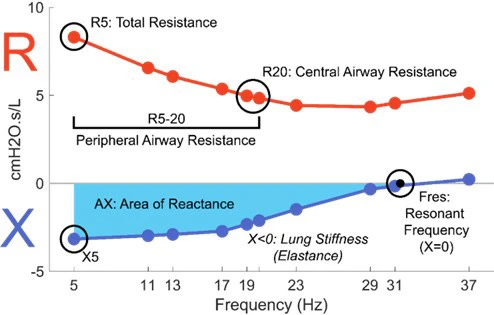
R is the resistance to airflow and mainly depends on airway radius when measured at frequencies of 5 Hz and above. Higher values of R indicate increased airway obstruction. R measured at a low frequency of 5 or 7 hertz represents total airway resistance in the respiratory system. R measured at higher frequencies, such as 19 or 20 hertz, reflects resistance in the central airways.

Typically, there is little variation in R with frequency in adults, and the difference between total and central airway resistance is small. However, a large difference between these values—also known as frequency dependence of resistance—can indicate increased obstruction in the small peripheral airways and variability in ventilation across lung regions.

Reactance (X) is the other component of respiratory system impedance and reflects the elastic and inertial properties of the lungs. X changes from negative to positive as oscillation frequency increases. When X is negative, the elastance component of reactance dominates and reflects stiffness of the respiratory system. Elastance is the inverse of compliance.

Positive values of X measured at higher frequencies represent the inertial properties of airflow through the lungs. The frequency at which X equals zero—where elastic and inertial forces are balanced—is called the resonant frequency, or Fres. A higher resonant frequency suggests that elastic properties dominate, meaning the lungs are stiffer and more difficult to inflate.

Reactance is often summarized as the area under the reactance curve, referred to as AX. This is the triangular area bounded by the low-frequency reactance (X5 or X7) and the resonant frequency. A larger AX reflects greater heterogeneity in ventilation, meaning fewer aerated regions of the lung, which can occur due to airway obstruction or collapse. A less compliant, stiffer lung is associated with more negative low-frequency X values, a higher resonant frequency, and a larger AX.

Respiratory impedance generally decreases, or improves, with larger lungs, taller stature, and more developed airway structures. This means that R decreases toward zero and shows less frequency dependence with increased height. Similarly, the negative elastic component of X moves toward zero (becoming less negative), while AX and resonant frequency decrease with increasing height.

In the clinical setting, oscillometry measurements can be used to assess responsiveness to bronchodilators. In a child with asthma, for example, resistance at 5 hertz and the frequency dependence of resistance may decrease after bronchodilator use, while reactance values shift toward zero. Together, these changes indicate reduced airway obstruction, improved lung compliance, and better airflow.

Current guidelines suggest a significant bronchodilator response with at least a 40% decrease in low-frequency resistance, a 50% increase in low-frequency reactance, and an 80% decrease in AX compared to baseline measurements.

In summary, oscillometry is a valuable clinical tool that can be used from a very young age to evaluate bronchodilator response and airway reactivity, distinguish between large and small airway obstruction, and identify ventilation heterogeneity. Because it is a sensitive measure capable of detecting small changes in lung function, it can also provide meaningful feedback about the effectiveness of treatment over time.

Clinical Perspectives

How Does Oscillometry Work?

Oscillometry applies different frequencies of airflow or pressure, through sound waves, at the mouth during normal breathing. These sound waves are usually taken within a frequency range of 5 to 40 Hertz, which is higher than the frequency of normal breathing. The device then measures the oscillating pressure or flow generated by the lungs in response.  

Oscillometers used different techniques to generate these waves. The forced oscillation technique (FOT) delivers multi-frequency sinusoidal waves whereas the impulse oscillometry systems (IOS) deliver square waves as trains of individual frequencies. 

Oscillometry measures impedance (total opposition to airflow), which has components:

  1. Resistance (R): The degree of airway obstruction in the lungs (aka openness of airways)
  2. Reactance (X): The compliance (stiffness/elastance) of the lung tissue (aka expandability of airways)
What Are Key Terms in Oscillometry?

Impedance = Resistance + Reactance

  • Impedance: is the total opposition to airflow
  • Resistance (R): The degree of airway obstruction in the lungs
  • Reactance (X):  The compliance (stiffness/elastance) of the lung tissue. How much the lungs can stretch and recoil.  

It is the resistance to airflow through the lung and is composed of:

  • Airway Resistance – Resistance from air moving through the airways
  • Tissue Resistance (tissue viscous resistance) – Opposition from the elastic recoil and deformation of lung and chest wall tissues

In most situations, the airways are the major contributors to the respiratory resistance such that R is a measurement of airway caliber. 

  • Compliance: The elasticity of the lung tissue.  How much the lungs can stretch and recoil. By convention, this is expressed in negative terms.
  • Inertia: The mass of the air in the airways and is expressed in positive terms – as it is the energy expended by the pulse waves as it travels along the airways.  
  • Airway Diameters: a small change in radius of an airway significantly affects resistance (degree of airway obstruction)
  • Airflow Velocity/Turbulence: Turbulent flow (larger airways, high speed) creates more resistance than smooth laminar (smooth) flow (smaller airways, lower speed)
  • Air Viscosity and Length: Thicker air (viscosity) and longer airways increase resistance
  • Lung Volume/Chest Wall: Changes during breathing affect airway diameter and tissue elasticity.
  • Area of Reactance (AX): On the oscillometry test results, the area under the reactance curve from the lowest frequency to the resonant frequency (Fres).
  • Resonant Frequency (Fres): The frequency where Xrs equals zero.    
graph of the resistance chart
How Does Oscillometry Compare to Spirometry?

Oscillometry, like spirometry and plethysmography, are objective lung function tests.  This chart provides a comparison between these two objective lung function tests.   

Spirometry and Oscillometry: Evidence Based Comparison Chart

FeatureSpirometryOscillometry
What this objective test measures bestLarge airway dynamicsPeripheral / small airway dynamics
Key measuresMeasures lung volumes and airflow:
  • FVC (Forced Vital Capacity)
  • FEV1 (Forced expiratory flow in 1st second)
  • Ratio for FEV1/FVC
Measures respiratory impedance using small amplitude oscillatory multi-frequency waves delivered at the mouth to measure respiratory:
  • Resistance
  • Reactance
Primary useGold-standard for the diagnosis of airflow obstruction (asthma, COPD)Highly sensitive to small-airway dysfunction, therefore useful across asthma, COPD, and other conditions for early detection or response to treatment
Level of patient effort requiredRequires forceful, maximal effort, often difficult for young children, elderly, or patient with illnessEffort-independent, requiring only tidal breathing – easier for young children and elderly and can be used in situations where spirometry is contra-indicated
Sensitivity to small-airway diseaseLimited; FEF 25-75 may correlate but inconsistentlySuperior sensitivity to small airway dysfunction, early detection of COPD symptoms and airway abnormalities
Measured dynamically or at restChallenges airways through forced expiratory flow which reveals abnormalitiesMeasures airways during normal breathing conditions and identifies abnormalities at rest
Bronchodilator response detectionChanges in FEV1/FVC used to assess responsivenessChanges in Resistance (R) and Reactance (X) used to assess responsiveness
More sensitive to detect bronchodilator responsiveness
Test durationLonger – requires repeated coached maneuvers and rest periodsShorter, quick to perform (30–60 second maneuvers)
Key metric to aid in medication therapyFEV1 guides medication therapy in asthma – NHLBI 2007
FEV1, along with patient’s symptoms and exacerbation risk, guide COPD therapy
No established metric to guide medication therapy
Patient burdenMay provoke cough, breathlessness, and fatigue (e.g. IPF)Associated with less symptom burden
Ideal populationsOlder children and adults who can follow instructionsAnyone but particularly very young children (>3 years), patients with cognitive or language barriers through lifespan
What Is the Clinical Usefulness of Oscillometry?
  • Be used across the lifespan
  • Assess young children
  • Monitor an individual’s environmental or occupational exposures over time
  • Provide insight into airway caliber
  • Assess reduced lung compliance
  • Detect small airway dysfunction
  • Track treatment response after bronchodilator or anti-inflammatory therapy
  • Predict COPD exacerbations
  • Manage disease long-term

Oscillometry may lead to improved health outcomes by:

  • Objectively evaluate early changes in respiratory health and response to medication therapy in populations when other meds are not available.
  • Predicting COPD exacerbations. 
  • Informing treatment responsiveness and treatment plans during an asthma exacerbation 
  • Reactance parameters were found to be more sensitive in identifying poor asthma control than spirometry, supporting the use of oscillometry to complement spirometry in the clinical management of asthma
  • By assessing lung abnormalities early, oscillometry may then reduce the need for medications which could then reduce healthcare costs and the long-term effects of high-dose inhaled corticosteroids.  

The current gold standard test used to diagnosis asthma and COPD is spirometry. For this reason, most experts recommend that oscillometry should not be used as a standalone diagnostic tool but rather in conjunction with spirometry, plethysmography, and clinical history and other investigations such as chest imaging and appropriate blood work.

However, oscillometry can be clinically useful as outlined above in the “What Is the Clinical Usefulness of Oscillometry in the Assessment and Management of Lung Disease” section.

Indications for oscillometry use include:

  1. If the patient is unable to perform spirometry, oscillometry is recommended (i.e. too young, too old, or situations where patients are unable to follow instruction to perform spirometry; presence of contraindication to forced expiratory maneuvers but at risk for undiagnosed lung disease). Normal oscillometry can rule out underlying lung disease. Abnormal oscillometry indicates need for further assessment. 
  2. If results from spirometry are normal, but the patient remains symptomatic, oscillometry is recommended and subsequent follow up is indicated. 
  3. Oscillometry can be helpful in early detection and diagnosis of lung disease as it is more sensitive than spirometry at assessing small airway dysfunction.
  4. Oscillometry can be used to monitor medication treatment response.
  5. Monitor an individual’s environmental or occupational exposures over time. 
  6. Oscillometry can also help predict COPD exacerbations and can be used during an exacerbation to inform treatment. 
  7. Assess bronchodilator responses and airway hyperresponsiveness when spirometry is not possible or in addition to spirometry. 
Considerations When Implementing an Oscillometry Test

When implementing oscillometry in clinical practice, consider the following:

  1. Have at least one clinic staff adequately trained in performing the procedure. 
  2. Establish written protocols and procedures to match the intended use and audience 
  3. Testing can be performed in an exam or procedure room. Some devices are portable and can be performed at bedside.
  4. Oscillometry should be conducted first, if other lung function tests such as spirometry are planned during the same clinic visit. This ensures that oscillometry is evaluated at FRC. Tests that require deep breaths and forced maneuvers will change the lung volume.
  5. Testing generally takes 15 minutes if it measures a patient’s baseline lung function. If obtaining a pre- and post-bronchodilator response, 30 minutes should be allocated.

See “How to conduct an oscillometry test” section in the downloadable “Oscillometry:  A toolkit for healthcare professionals” for more information.  

Steps to conduct an oscillometry test include:

  1. Equipment and software set up
  2. Patient preparation
  3. Quality control during the test
  4. Determine acceptable measurements
  5. Determine measurement exclusion
  6. Ensure measurement repeatability
  7. Post-bronchodilator response – optional
  8. Reporting results

Steps to Oscillometry Interpretation:

Please refer to the video above and the downloadable Oscillometry: A toolkit for healthcare professionals for further details on oscillometry test result interpretation.

Steps to interpretating oscillometry test results include:

  1. Check quality metrics (COV1 coherence)
    1. Coefficient of Variation: <10% for adults, <15% for children (R5 parameter)
    2. Repeat at least 3 tests for a valid session
  2. Review R5, total resistance
    1. R5 (resistance at 5Hz) reflects the total respiratory system resistance from central and peripheral airways
    2. Increased R5 suggests overall airway narrowing, as in asthma, COPD, or acute bronchoconstriction.
    3. Normal R5 means total airway resistance is within expected limits
  3. Review R5-R20, small airway resistance
    1. R20 (resistance at 20 Hz) primarily reflects large/central airways
    2. R5-R20 means small airway narrowing, often the earliest sign of obstructive lung disease
    3. A normal R20 but elevated R5-R20 can indicate isolated small airway disease
    4. R19 and R5-19 can be interpreted in the same way as R20 and R5-20
  4. Review X5:   Small airway reactance
    1. X5 (reactance at 5 Hz) reflects the elastic and inertial properties of peripheral airways
    2. More negative increased X5 values means stiffer, less compliant small airways
    3. This is seen in restriction, such as fibrosis or interstitial lung disease and in severe small airway obstruction, such as asthma and COPD
  5. Review AX:   Area under the Reactance Curve
    1. AX is the integrated area under the reactance curve from 5 Hz to Fres (resonant frequency or zero-crossing)
    2. Increased AX indicates greater small airway dysfunction and can amplify findings from X5
    3. AX is highly sensitive to early changes in small airways
  6. Identify the pattern (peripheral, restrictive, obstructive)
  7. Add within-breath analysis, expiratory flow limitation or inspiratory flow limitation detection
  8. Consider reversibility, pre- and post-bronchodilator

According to technical standards supported by the American Thoracic Society (ATS) and European Respiratory Society (ERS), oscillometry (FOT) is used to detect asthma through measures of increased respiratory resistance (R) and reactance (X).   Recommended bronchodilator responsiveness (BDR) thresholds for asthma, based on the 95th percentile in healthy individuals, are defined as:

  • R5 ↓ by ≥40%
  • X5 ↑ by ≥50%
  • AX ↓ by ≥80%
  • Lack of device and software standardization
  • Limited guideline support
  • Interpretation challenges
  • Technical challenges
  • Clinical efficacy evidence
  • Cost and equipment availability
  • Inability to bill for both oscillometry and spirometry at the same visit.  
  • Cost and equipment availability 

The Mechanics of Oscillometry

How Does Oscillometry Use Sound Waves to Measure Lung Function?

In oscillometry, sound waves are artificially generated pressure oscillations that ride on top of a person’s normal breathing (tidal breathing). 

1. A loudspeaker (or a piston or a vibrating mesh) inside the oscillometry device is used to generate sound waves.

  • The speaker diaphragm moves back and forth.
  • This motion creates small pressure fluctuations in the air—basically sound waves.

2. How the oscillations enter the lungs

  • The patient breathes normally through a mouthpiece.
  • While the patient breathes, the device superimposes these sound waves into the airflow.
  • The oscillations are low-amplitude (gentle) and usually low frequency (about 5–35 Hz).

3. As the sound waves travel inside of the airways

  • Some energy is resisted by airway narrowing and friction.
  • Some energy is stored and released by the elastic tissues of the lungs.
  • Some energy reflects back due to changes in airway size.

This interaction changes the phase and amplitude of the sound waves.

4. Sensitive sensors measure:

  • Pressure changes
  • Flow changes

From these pressure and flow changes, the oscillometry device calculates respiratory impedance (total opposition), which includes:

  • Resistance (R) (airway obstruction) 
  • Reactance (X) (stiffness/elastance) 

5. Sound waves are perfect to be used for lung function measurement because they:

  • Travel easily through air
  • Can probe different airway sizes depending on frequency
  • Do not require forced breathing

By measuring how these waves change as they travel through the airways, the device can calculate respiratory impedance (total opposition), separating airway resistance (airway obstruction) and reactance (stiffness/elastance). Using different frequencies helps the system assess both large and small airways.

How to Conduct an Oscillometry Test
  1. Refer to the manufacturer's instruction manual for specific device instructions. 
  2. Select New Patient, if appropriate, and enter the patient's information such as first and last names, date of birth, birth sex, height, weight and smoking history. 
  3. Ensure that the correct waveform is selected depending on the device.  
  4. King (2020) recommends performing regular biological controls as part of your clinic’s procedures. 
  5. Ensure that the appropriate set of reference values is selected (Deprato, 2022). Chang (2022) recommends the following reference values: Oostveen or Brown for adults and Nowowiejska for children ages 3 to 17. However, newer reference equations for pediatrics are now available (Ducharme, 2025). 
    NOTE: The preferred and availability of reference values may differ depending on the patient population and oscillometry device manufacturer. It is ideal to use the reference equations developed with the specific device that is being used. 
  1. Follow the normal screening procedures for the pulmonary function lab or clinic. There is no evidence that oscillometry transmits respiratory pathogens (Wu, 2021). 
  2. Ensure that the patient has not had any recent dental or facial surgeries, such as tooth extractions, and can form a proper tight seal around the mouthpiece. 
  3. Ensure that the patient is as relaxed as possible, is not wearing tight-fitting clothing and withholds from tobacco use and vigorous exercise at least 1 hour prior to testing. 
  4. Perform oscillometry prior to other pulmonary function tests, such as spirometry or exhaled nitric oxide (FeNo) testing.  
  5. Withhold bronchodilators prior to testing, unless otherwise instructed by a referring provider. Record patient's usage of bronchodilators, dosage, time/date of last administration and any medication allergies. 
  6. Verify the patient's information: first and last names, date of birth, birth sex and height. 
  7. Measure the patient's height without shoes, with feet together, standing as tall as possible with the eyes level and looking straight ahead, and the back flush against a wall or flat surface.  
    NOTE: For patients unable to stand erect, height may be estimated using arm span. For patients aged 25 years or older, where height measurements have been made previously in the same laboratory, remeasuring height at subsequent visits within 1 year may not be necessary. 
  1. Attach a single-patient-use bacterial/viral filter to the oscillometry device.
  2. Ensure that the oscillometry device is ready in the testing mode.
  3. Explain the test to the patient.
    • Describe the sensation generated by oscillations such as "vibrations" or "fluttering."
    • Instruct the patient to breathe normally while holding their cheeks with their palm and fingers and using their thumbs to support the soft tissue of the jaw during measurements. If they are unable to hold their cheeks themselves, you may hold it for them.
    • Explain to the patient that swallowing should be avoided and the tongue must be below the mouthpiece during the test.
    • It can be helpful for younger children to first handle and put on the nose clips and practice putting the oval end of the filter in their mouth.
  4. Positioning:
    • Device:If holding the device, the operator should sit or stand in front of the patient and be able to view both the patient and the computer screen showing the measurement recording.
      • If using a support arm, make sure the device is positioned so the mouthpiece is directly in front of the participant’s mouth and the participant’s torso is upright without slouching down or reaching up.
    • Patient:The patient should sit upright in a chair with feet on the floor, or they may sit in their caregiver’s lap.
      • The operator can stand behind the participant to hold cheeks while watching the screen and checking for mouth seal.
  5. Cheek Support: The patient (if able) should gently support their cheeks with their hands with thumbs under jawbone (not too tight). If unable, another person can stand behind the patient and apply very gentle pressure to the patient’s cheeks. If a patient is sitting in a caregiver’s lap, a caregiver can hold cheeks.
  6. Nose clip: Nose clip should completely seal the nasal passages. Use tissue paper if the nose clip is slipping. If a child is not tolerating, another person can gently pinch the child’s nose shut.
  7. Mouth Seal: Mouth should completely seal around the filter opening so that there is no air leak.
  8. Tongue: Tongue should not occlude filter opening and can be positioned under the filter opening.
  9. Head Tilt: Gently position the device such that the participant faces approximately 15 degrees upwards from the horizontal plane to ensure there is no compression on the upper airways that could lead to elevated resistance readings.
  10. For young children, a video may provide a needed distraction. Ensure the video screen is directly in front of the participant or slightly above eye level during the test.
  11. Ask the patient to wet his/her lips before wrapping them around the mouthpiece to form a proper, tight seal.
  12. Instruct the patient to continue steady, quiet breathing through the filter. NOTE: Supplementary oxygen must be turned off during measurements to avoid any drift into the oscillometry device.
  13. Remind the patient of the 30 second test duration and the minimum requirement of three measurements.
  14. Before starting the test, watch for at least 3 steady breaths on the testing screen to ensure that the patient is breathing at their normal resting respiratory rate. It is helpful to take a baseline respiratory rate before doing the test for reference. Coach patients to slow breathing rate if they are breathing faster than normal.
  15. Start recording. Continue watching patient and screen, coach gentle steady breathing with consistent tidal volume and respiratory rate, and make sure mouth is sealed around the filter. NOTE: During the test, inform the patient of the time remaining during each measurement.
  1. Ensure that the patient’s breathing during the test is representative of their resting breathing state before they start the test.
  2. During the measurement recordings, watch the breathing traces and patient behavior. Things to observe and correct:
    • Leak around the mouthpiece
    • Nasal passages not fully occluded
    • Rapid breathing that was not present before the test started
    • Very slow or deep breathing that was not present before the test started
    • Irregular/variable breathing or combinations of rapid/deep/shallow breathing
    • Breath holding or glottis closure
    • Tongue occluding the mouthpiece opening
    • Swallowing, coughing, laughing, talking, or humming
  3. Measurement Acceptability: At least 3 (ideally at least 5) breaths that are free from artifact in each recording.
    • Oscillometry device software programs may have algorithms that automatically exclude breaths with artifacts, and manual exclusions may be possible.
    • Note: Children normally have a higher respiratory rate and will have many breaths over a 20–30 second recording. Adults will have a slower respiratory rate and the recording time may need to be extended to have 3–5 breaths in one recording.
    • The R and X values that are reported for each individual recording are averaged from the non-excluded data collected over that recording period.
  4. After obtaining the first 1–2 measurements, review the results and the breathing traces and coach the patient if needed. Look for steady breathing in the time traces—there should be minimal variation in tidal volume and respiratory rate during the recording. Impedance measurements are sensitive to breathing volume and rate. It is important for the breathing volume and rate to reflect the patient’s resting state.
  5. Review the plots of R and X across the spectrum of frequencies measured.
    • Typically, R at the lowest frequency (e.g., R5) will be greater than or similar to R at the next highest frequency (e.g., R10 or R11). The R curve should not bend significantly towards zero.
    • Similarly, X at the lowest frequency (e.g., X5) should be less than X at the next highest frequency (e.g., X10 or X11). The X curve should not bend significantly towards zero.
    • If these paradoxical curved bends are present, this could indicate leaking and/or panting into the device. Check that the patient has a proper mouth seal and is breathing at their resting rate.
    • Caution should be used in interpreting the 5 Hz values in these cases as they may be artificially closer to zero due to breathing and/or signal processing artifact.
    • If available, choice of a pediatric waveform starting at a higher frequency (e.g., 7 or 8 Hz) may improve results in the preschool age group who naturally have a higher respiratory rate.
  6. Continue taking 3–4 more measurements and reviewing results.
    • Unlike spirometry, where the single “best” maneuver is selected for reporting, the current convention is to report the average of each R and X value from at least 3 acceptable measurements.
    • It is advisable to take more than the minimum of three measurements to ensure the possibility of including at least 3 acceptable measurements on average.
  7. Measurement Exclusion:
    • Measurements with breathing artifacts/abnormal patterns or obvious abnormalities, or that do not include at least 3 whole breaths, should be excluded from the test average.
    • R and X curves that fall significantly out of the cluster of the other measurement curves (clear outliers) and are accompanied by breathing artifact or evidence of non-resting breathing patterns should be excluded from the test average.
    • Coherence is a statistical measure that shows how reliable the signal is between the pressure oscillations sent into the airway and the airflow measured coming out. High coherence (close to 1) means there is a good signal, little noise, and a reliable measurement. Low coherence means the signal is contaminated by noise, irregular breathing, coughing, swallowing, leaks, or movement. In the past, coherence was used to judge if a test was good quality. However, current guidelines indicate that you should not rely on coherence as a standalone criterion for measurements of acceptability.
  8. Measurement Repeatability:
    • An acceptable test has at least 3 repeatable measurement recordings that each have 3–5 acceptable breaths.
    • Per current guidelines, repeatability means that the coefficient of variation (CoV = standard deviation/mean) in R5 (or the lowest frequency resistance) is:
      • CoV < 15% in children
      • CoV < 10% in adults
    • In addition, the R and X curves should not show significant variability across the frequency spectrum.
  1. Administer bronchodilator via a valued-holding chamber. Ensure acceptable technique. 
  2. Record the method and number of doses administered.  
  3. Wait for at least 15 minutes.  
  4. Repeat above testing steps assess post-bronchodilator response  
  1. Discard patient's mouthpiece and nose clip.
  2. Use disinfectant wipes to clean the oscillometry device and patient's chair.
  1. Include patient's first and last names, height, age, and birth sex.
  2. Include input signal frequencies and duration of individual recordings.
  3. Report the mean of acceptable and reproducible measurements and the CoV for these reported measurements.
  4. Select and report reference equations.
  5. Include impedance graph demonstrating Rrs and Xrs versus oscillation frequency.
  6. Include post-bronchodilator response with dosage and method of administration including z-scores and absolute percentage change - optional
What Factors Should Be Considered When Selecting an Oscillometer?

The following factors should be considered when selecting an oscillometer for a clinic setting:

  • FDA approval for intended clinical use 
  • Clinical validation data demonstrating accuracy, repeatability, and sensitivity 
  • Measurement parameters available (e.g., R5, R20, X5, AX, Fres) 
  • Quality control algorithms (coherence, leak detection, artifact rejection) 
  • Reference equations included and appropriateness for patient population 
  • Age range and feasibility (pediatric, adult, elderly) 
  • Ease of operation and consistency between operators 
  • Patient coaching aids (real‑time feedback, animations, visual cues) 
  • Turnaround time per test for busy clinic workflows 
  • Report clarity to aid clinical interpretability 
  • Data connectivity (electronic health record integration, export formats) 
  • Physical footprint and portability within clinic spaces 
  • Consumables and infection control compatibility 
  • Calibration procedures and ongoing maintenance needs 
  • Total cost of ownership (device, software, disposables, service) 
  • Vendor support, software updates
  • Training availability
How Is Oscillometry Coded for Legal and Appropriate Reimbursement?

Oscillometry is a reimbursable lung function test.  

CPT Code for Oscillometry

  • 94728: Airway resistance by impulse oscillometry.

Coding considerations

  • Bundling: Code 94728 cannot be reported with certain other pulmonary function tests, such as spirometry (94010) or bronchodilator response (94060).  If billed with another CPT code with a status indicator of S, T or V, it will be bundled (i.e. 94010, 94060, 94070, 94375, 94726).
  • Specificity: Always check the specific type of test performed to ensure the correct code is used, as there may be other codes for different types of airway resistance or lung volume measurements.
  • Modifiers: Modifiers may be needed in certain situations. For example, Modifier 26 (Professional Component used when billing only the provider’s professional work, but not the equipment, supplies, or technical side) and TC (Technical Component when the provider bills only the technical portion of a service and not the provider’s interpretation) can be used when the professional and technical components of the service are provided by different entities.
  1. Abdo, M., et al. (2023). Minimal clinically important differences in asthma outcomes. European Respiratory Journal, 61(3), 2201793. https://doi.org/10.1183/13993003.01793-202 
  2. Bates, J. H. T., Irvin, C. G., Farré, R., & Hantos, Z. (2011). Oscillation mechanics of the respiratory system. Comprehensive Physiology, 1(3), 1233–1272. https://doi.org/10.1002/cphy.c100058  
  3. Berger, K. I., Wohlleber, M., Goldring, R. M., Reibman, J., Farfel, M. R., Friedman, S. M., … Shao, Y. (2021). Respiratory impedance measured using impulse oscillometry in a healthy urban population. ERJ Open Research, 7(1). https://doi.org/10.1183/23120541.00560-2020 
  4. Bhattarai, P., et al. (2020). Clinical application of forced oscillation technique (FOT) in early detection of airway changes in smokers. Journal of Clinical Medicine, 9(9), 2778. https://doi.org/10.3390/jcm9092778  
  5. Biswas, R. (2025, July 16). How to Interpret PulmoScan oscillometry data. PulmoScan. Retrieved Feb 1, 2026 from https://pulmoscan.cognitalabs.com/how-to-interpret-pulmoscan-oscillometry-data/ 
  6. Brown, N. J., Xuan, W., Salome, C. M., Berend, N., Hunter, M. L., Musk, A. W., James, A. L., & King, G. G. (2010). Reference equations for respiratory system resistance and reactance in adults. Respiratory Physiology & Neurobiology, 172(3), 162–168. https://doi.org/10.1016/j.resp.2010.05.013 
  7. Brashier, B., & Salvi, S. (2015). Measuring lung function using sound waves: Role of the forced oscillation technique and impulse oscillometry system. Breathe, 11(1), 57–65. https://doi.org/10.1183/20734735.020514  
  8. Chang, E., Vasileva, A., Nohra, C., Ryan, C. M., Chow, C.-W., & Wu, J. K. Y. (2022). Conducting respiratory oscillometry in an outpatient setting. Journal of Visualized Experiments, (182), Article e63243. https://doi.org/10.3791/63243 
  9. Children’s Colorado Pediatric Professionals. (2023, January 27). Measuring lung function with oscillometry [Video]. YouTube. https://www.youtube.com/watch?v=70C_etF84aA 
  10. Corazalla, Edward O.   Personal communication.  January 28, 2026. 
  11. Cottee, AM, Seccombe, LM, Thamrin C, King GG, Peters MJ, Farah CS.. (2020). Bronchodilator response assessed by the forced oscillation technique identifies poor asthma control with greater sensitivity than spirometry. Chest, 157(6), 1435–1441. https://doi.org/10.1016/j.chest.2019.12.035  
  12. Dellacà, R. L., et al. (2004). Detection of expiratory flow limitation in COPD using the forced oscillation technique. European Respiratory Journal, 23(2), 232–240. https://doi.org/10.1183/09031936.04.00046804  
  13. Deprato, A., Ferrara, G., Bhutani, M., et al. (2022). Reference equations for oscillometry and their differences among populations: A systematic scoping review. European Respiratory Review, 31(165). https://doi.org/10.1183/16000617.0021-202  
  14. Desormeau, B., Smyrnova, A., Drouin, O., & Ducharme, F. M. (2023). Real-life impact of oscillometry in clinical assessment of preschoolers with asthma. Respiratory Medicine, 209, 107148. https://doi.org/10.1016/j.rmed.2023.107148  
  15. Donohue, P. A., & Kaminsky, D. A. (2024). The role of oscillometry in asthma. Current Opinion in Pulmonary Medicine, 30(3), 268–275. https://doi.org/10.1097/MCP.0000000000001057  
  16. Ducharme, F. M., & Chan, R. (2025). Oscillometry in the diagnosis, assessment, and monitoring of asthma in children and adults. Annals of Allergy, Asthma & Immunology, 134, 135–143. https://doi.org/10.1016/j.anai.2024.11.013  
  17. Elias, D. B., Amin, R., et al. (2026). Reversible airway obstruction on impulse oscillometry in preschool children with bronchopulmonary dysplasia. The Journal of Pediatrics. https://doi.org/10.1016/j.jpeds.2026.115013  
  18. Global Initiative for Asthma.  (2025).   Global Strategy for Asthma Management and Prevention.  https://ginaasthma.org 
  19. Gochicoa-Rangel, L., & Vargas, M. H. (2025). How best to choose an oscillometer and reference equations for your patients with asthma. Annals of Allergy, Asthma & Immunology, 134, 159–164. https://www.annallergy.org/article/S1081-1206(24)01681-8/fulltext  
  20. Global Initiative for Chronic Obstructive Lung Disease. (2025). Global strategy for prevention, diagnosis and management of chronic obstructive pulmonary disease (2025 report). Retrieved from https://goldcopd.org/2025-gold-report/ 
  21. Gupta, N., Sachdev, A., Gupta, D., & Gupta, S. (2021). Oscillometry–The future of estimating pulmonary functions. Karnataka Pediatric Journal, 35(2), 79–87. https://doi.org/10.25259/KPJ_25_2020 
  22. Hellinckx, J., De Boeck, K., Bande-Knops, J., et al. (1998). Bronchodilator response in 3–6.5yearold healthy and stable asthmatic children. European Respiratory Journal, 12, 438–443. https://doi.org/10.1183/09031936.98.12020438  
  23. Hellyer, N., et al. (2017). Comparison of diaphragm thickness measurements among postures via ultrasound imaging. PM&R, 9(1), 21–25. https://doi.org/10.1016/j.pmrj.2016.06.001  
  24. Hickman, N., Hughes, A. L., Biswas, P., et al. (2023). Early detection of acute exacerbation of chronic obstructive pulmonary disease (AECOPD) using athome lung oscillometry. American Journal of Respiratory and Critical Care Medicine, 207(Suppl.), A4499. https://doi.org/10.1164/ajrccm-conference.2023.207.1_MeetingAbstracts.A4499  
  25. Huang, Y., Zhang, X., Wang, J., et al. (2025). Role of impulse oscillometry in chronic obstructive pulmonary disease and asthma–chronic obstructive pulmonary disease overlap. Clinical and Translational Allergy, e70057. https://doi.org/10.1002/clt2.70057  
  26. Ishikawa, T., Nishikiori, H., Mori, Y., Fujino, K., Saito, A., Takahashi, M., Kuronuma, K., Hinotsu, S., & Chiba, H. (2024). The impact of respiratory reactance in oscillometry on survival in patients with idiopathic pulmonary fibrosis. BMC Pulmonary Medicine, 24, 10. https://doi.org/10.1186/s12890-023-02776-y 
  27. Kaminsky, D. A., Simpson, S. J., Berger, K. I., et al. (2022). Clinical significance and applications of oscillometry. European Respiratory Review, 31(163), 210208. https://doi.org/10.1183/16000617.0208-2021  
  28. King, G. G., Bates, J., Berger, K. I., et al. (2020). Technical standards for respiratory oscillometry. European Respiratory Journal, 55(2), 1900753. https://doi.org/10.1183/13993003.00753-2019  
  29. Krishnan, B., Kannukettiyil, N. J., & Gopal, A. (2025). Oscillometry versus spirometry: Initial insights. International Journal of Clinical Studies & Medical Case Reports. https://ijclinmedcasereports.com/pdf/IJCMCR-RW-01278.pdf  
  30. Liang, X., Zheng, J., Gao, Y., et al. (2022). Clinical application of oscillometry in respiratory diseases: An impulse oscillometry registry. ERJ Open Research, 8(4), 000802022. https://doi.org/10.1183/23120541.00080-2022  
  31. Makrinioti, H., Fainardi, V., Bønnelykke, K., et al. (2024). ERS statement on preschool wheezing disorders. European Respiratory Journal, 64(3). https://doi.org/10.1183/13993003.00257-2024  
  32. Malmberg, L. P., Pelkonen, A. S., Haahtela, T., et al. (2003). Exhaled nitric oxide rather than lung function distinguishes preschool children with probable asthma. Thorax, 58, 494–499. https://doi.org/10.1136/thorax.58.6.494 
  33. Matos, R. I., McEvoy, C. T., & Jensen, E. A. (2025). Reversible airway obstruction on impulse oscillometry in preschool children with bronchopulmonary dysplasia. Pediatric Pulmonology. Advance online publication. https://pubmed.ncbi.nlm.nih.gov/41638357/ 
  34. Mondal P, Yirinec A, Midya V, et al. Diagnostic value of spirometry vs impulse oscillometry: A comparative study in children with sickle cell disease. Pediatric Pulmonology. 2019; 54: 1422-1430. https://doi.org/10.1002/ppul.24382 
  35. Mou, T., Wang, Y., Fu, Y., et al. (2024). Analysis of the correlations and inconsistencies between spirometry and impulse oscillometry in the diagnosis of smallairway dysfunction. BMC Pulmonary Medicine, 24, 619. https://doi.org/10.1186/s12890-024-03420-z  
  36. National Asthma Education and Prevention Program, Third Expert Panel on the Diagnosis and Management of Asthma. (2007). Expert Panel Report 3 (EPR-3): Guidelines for the diagnosis and management of asthma (NIH Publication No. 07-4051). National Heart, Lung, and Blood Institute, National Institutes of Health. https://www.nhlbi.nih.gov/health/pro/guidelines/current/asthma-guidelines 
  37. Navanandan, N., Hamlington, K. L., Mistry, R. D., Szefler, S. J., & Liu, A. H. (2020). Oscillometry for acute asthma in the pediatric emergency department: A feasibility study. Annals of Allergy, Asthma & Immunology, 125(5), 607–609. https://doi.org/10.1016/j.anai.2020.07.002  
  38. Navanandan, N., et al. (2025). Clinical applications of impulse oscillometry in pediatric respiratory disease. Pediatric Pulmonology. Advance online publication. https://pubmed.ncbi.nlm.nih.gov/40705565/  
  39. Navanandan, N., et al. (2025). Impulse oscillometry measures associated with asthma control and exacerbations in children. Annals of the American Thoracic Society. https://doi.org/10.1513/AnnalsATS.202502-205OC 
  40. Nowowiejska, B., et al. (2008). Transient reference values for impulse oscillometry for children aged 3–18 years. Pediatric Pulmonology, 43(12), 1193–1197. 
  41. O’Rourke, M. C., & Mendenhall, B. R. (2025). Transesophageal echocardiogram (TEE). StatPearls Publishing. https://www.ncbi.nlm.nih.gov/books/NBK430685/  
  42. Oostveen, E., MacLeod, D., Lorino, H., et al. (2003). The forced oscillation technique in clinical practice: Methodology, recommendations and future developments. European Respiratory Journal, 22(6), 1026–1041. https://doi.org/10.1183/09031936.03.00089403  
  43. Oostveen, E., et al. (2013). Respiratory impedance in healthy subjects: Baseline values and bronchodilator response. European Respiratory Journal, 42(6), 1513–1523. 
  44. Ostridge, K. (2019). The peak index: Spirometry metric for airflow obstruction severity and heterogeneity. Annals of the American Thoracic Society, 16(8), 974–975. https://doi.org/10.1513/AnnalsATS.201905-388ED  
  45. Park, H., Lee, H. J., Lee, H. W., et al. (2024). Diagnosis and evaluation of small airway disease and COPD using impulse oscillometry. Scientific Reports, 14, Article 79818. https://doi.org/10.1038/s41598-024-79818-w  
  46. Patel, S., Sylvester, K. P., Wu, Z., Rhamie, S., Dickel, P., Maher, T. M., Molyneaux, P. L., Calverley, P. M. A., & Man, W. D.-C. (2024). A comparison of respiratory oscillometry and spirometry in idiopathic pulmonary fibrosis: Performance time, symptom burden and test–retest reliability. ERJ Open Research, 10(4), 00227-2024. https://doi.org/10.1183/23120541.00227-2024 
  47. Pisi, R., et al. (2021). Detection of small airway dysfunction in asymptomatic smokers with preserved spirometry: The value of the impulse oscillometry system. International Journal of Chronic Obstructive Pulmonary Disease, 16, 2585–2590. https://doi.org/10.2147/COPD.S319972  
  48. Qvarnström, B., Engström, G., Frantz, S., et al. (2023). Impulse oscillometry indices in relation to respiratory symptoms and spirometry in the Swedish Cardiopulmonary Bioimage Study. ERJ Open Research, 9(5), 00736-2022. https://doi.org/10.1183/23120541.00736-2022  
  49. Rangel, L., Vargas, M. (2024). How best to choose an oscillometer and reference equations for your patients with asthma. Annals of Allergy, Asthma, and Immunology, 134 (2), 159-164. https://doi.org/10.1016/j.anai.2024.11.009  
  50. Ribeiro, C., Faria, A. C. D., Lopes, A. J., et al. (2018). Forced oscillation technique for early detection of the effects of smoking and COPD: Contribution of fractional order modeling. International Journal of Chronic Obstructive Pulmonary Disease, 13, 3281–3295. https://doi.org/10.2147/COPD.S173686 
  51. Saadeh, C., Saadeh, C., Cross, B., Gaylor, M., & Griffith, M. (2015). Advantage of impulse oscillometry over spirometry to diagnose chronic obstructive pulmonary disease and monitor pulmonary responses to bronchodilators: An observational study. SAGE Open Medicine, 3, 2050312115578957. https://doi.org/10.1177/2050312115578957  
  52. Safia, N., Mayuran, R., Merin, K. (2022).  Asthma diagnosis using patient-reported outcome measures and objective diagnostic tests: Now and into the future. Current Opinion in Pulmonary Medicine, 28(3), 251-257. https://doi.org/10.1097/MCP.0000000000000871  
  53. Sarkar, S., Jadhav, U., Ghewade, B., Sarkar, S., & Wagh, P. (2023). Oscillometry in lung function assessment: A comprehensive review of current insights and challenges. Cureus, 15(10), e47935. https://doi.org/10.7759/cureus.47935 
  54. Singh, D., Long, G., Cançado, J. E. D., & Higham, A. (2020). Small airway disease in chronic obstructive pulmonary disease: Insights and implications for the clinician. Current Opinion in Pulmonary Medicine, 26(2), 162–168. https://doi.org/10.1097/MCP.0000000000000637  
  55. Su, Z.-Q., Guan, W.-J., Li, S.-Y., Ding, M., Chen, Y., Jiang, M., Chen, X.-B., Zhong, C.-H., Tang, C.-L., & Zhong, N.-S. (2018). Significances of spirometry and impulse oscillometry for detecting small airway disorders in COPD and heavy smokers. International Journal of Chronic Obstructive Pulmonary Disease, 13, 3031–3044. https://doi.org/10.2147/COPD.S172639
  56. Takahashi, S., Shirai, T., & Akamatsu, T. (2023). Oscillometry helps assess treatment responsiveness in adults with asthma exacerbations. Respiratory Physiology & Neurobiology, 313, 104065. https://doi.org/10.1016/j.resp.2023.104065  
  57. Thamrin, C., Gangell, C. L., Udomittipong, K., et al. (2007). Assessment of bronchodilator responsiveness in preschool children using forced oscillations. Thorax, 62, 814–819. https://doi.org/10.1136/thx.2006.071290  
  58. Usmani, O. S., et al. (2021). Why we should target small airways disease in our management of chronic obstructive pulmonary disease. Mayo Clinic Proceedings, 96(9), 2448–2463. https://doi.org/10.1016/j.mayocp.2021.03.016  
  59. Veneroni, C., Valach, C., Wouters, E. F. M., et al. (2024). Diagnostic potential of oscillometry: A population based approach. American Journal of Respiratory and Critical Care Medicine, 209(4), 444–453. https://doi.org/10.1164/rccm.202306-0975OC  
  60. Wu, J. K. Y., Ma, J., Nguyen, L., Dehaas, E. L., Vasileva, A., Chang, E., Liang, J., Huang, Q. W., Cassano, A., Binnie, M., Shapera, S., Fisher, J., Ryan, C. M., McInnis, M. C., Hantos, Z., & Chow, C.-W. (2022). Correlation of respiratory oscillometry with CT image analysis in a prospective cohort of idiopathic pulmonary fibrosis. BMJ Open Respiratory Research, 9(1), e001163. https://doi.org/10.1136/bmjresp-2021-001163  
  61. Wu, J. K. Y., Ryan, C. M., Hiebert, R. J., Han, Z., Liu, A., Jeong, C.-H., Mubareka, S., Evans, G. J., & Chow, C.-W. (2021). Aerosol generation during pulmonary function testing: Monitoring during different testing modalities. Canadian Journal of Respiratory, Critical Care, and Sleep Medicine, 6(2), 1–8. https://doi.org/10.1080/24745332.2021.1965926 
  62. Wu, J. K. Y., Xu, J. J.-N., Numakura, T., Ryan, C. M., McInnis, M. C., Binnie, M., Shapera, S., Fisher, J. H., Hantos, Z., & Chow, C.-W. (2025). Standard pulmonary function tests and respiratory oscillometry patterns in hypersensitivity pneumonitis and idiopathic pulmonary fibrosis. BMJ Open Respiratory Research, 12(1), e003600. https://doi.org/10.1136/bmjresp-2025-003600  
  63. Zimmermann, S. C., et al. (2020). Day to day variability of forced oscillatory mechanics for early detection of acute exacerbations in COPD. European Respiratory Journal, 56(3), 1901739. https://doi.org/10.1183/13993003.01739-2019  
  64. Zhang, Y., Tanabe, N., Shima, H., et al. (2022). Physiological impairments on respiratory oscillometry and future exacerbations in chronic obstructive pulmonary disease patients without a history of frequent exacerbations. COPD: Journal of Chronic Obstructive Pulmonary Disease, 19(1), 149–157. https://doi.org/10.1080/15412555.2022.2051005

Page last updated: March 24, 2026

Freedom From Smoking Clinic - Portsmouth, OH
Portsmouth, OH | Mar 10, 2026
Asthma Basics Workshop
, NV | Apr 03, 2026